Curious Forest™ · Vinnu Vale

Vinnu Vale 🐘

"Listen carefully… every sloka has a story hidden inside it."

Start with the three daily essentials — morning, meal, and bedtime. More slokas wait below for the rest of the day. Word by word, in Telugu and English. Inspired by the teachings of Sri Nanduri Srinivas.

🌟 Three Daily Essentials

If you teach a child just three slokas — these are the three. They cover the whole arc of the day: waking, eating, and sleeping.

1🌅 Morning — upon waking, before your feet touch the ground

కరదర్శన శ్లోకం

Morning Hand Prayer
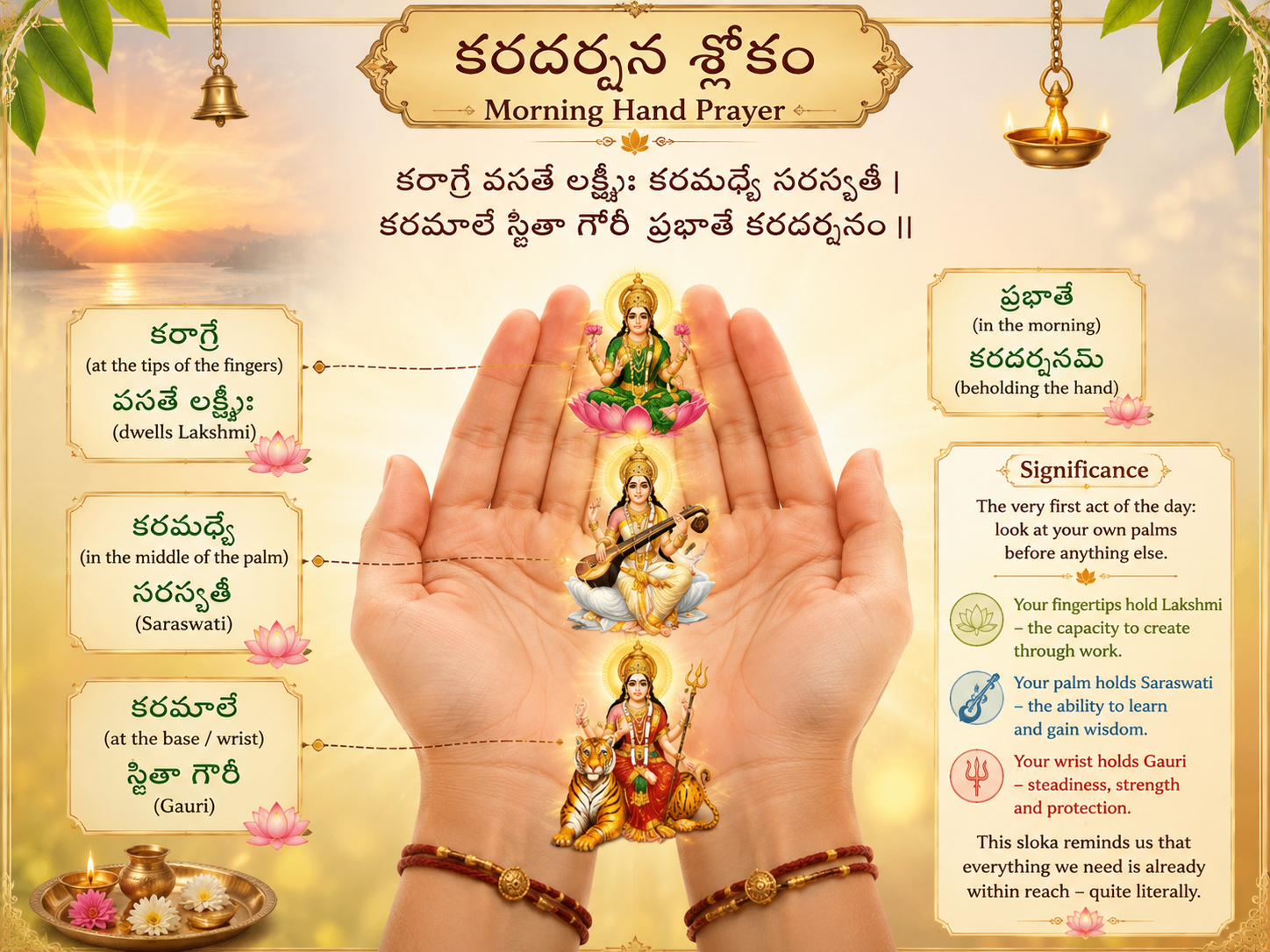
Morning Hand Prayer — కరదర్శన శ్లోకం: full sloka with word-by-word meaning and significance
Read as text

కరాగ్రే వసతే లక్ష్మీః కరమధ్యే సరస్వతీ |

కరమూలే స్థితా గౌరీ ప్రభాతే కరదర్శనమ్ ‖

Word by Word

కరాగ్రేat the tips of the fingers
వసతే లక్ష్మీఃdwells Lakshmi
కరమధ్యేin the middle of the palm
సరస్వతీSaraswati
కరమూలేat the base / wrist
స్థితా గౌరీGauri
ప్రభాతేin the morning
కరదర్శనమ్beholding the hand

Significance

The very first act of the day: look at your own palms before anything else. Your fingertips hold Lakshmi – the capacity to create through work. Your palm holds Saraswati – the ability to learn and gain wisdom. Your wrist holds Gauri – steadiness, strength and protection. This sloka reminds us that everything we need is already within reach – quite literally.

📝 Parent's Notestory, meaning & how to teach this

📖 The story behind Gauri

Long ago, a young woman named Parvati wanted to marry Shiva. But Shiva was lost in deep meditation, his eyes closed to the world. Instead of giving up, Parvati sat down and began to meditate harder than him. Through summer, winter, and monsoon — through hunger, cold, and exhaustion — she relied only on her own willpower.

By the end, she had become so radiant from sheer discipline that the world gave her a new name: Gauri, "the radiant one." Shiva opened his eyes and finally saw her.

This is the woman who lives at the base of your child's palm every morning. Not someone to be worshipped from afar — but proof that inner work is the real superpower.

🎮 Three queens, one controller

Your hand is your controller for the day. The sloka places three powers exactly where they make sense:

  • 🌸 Fingertips — Lakshmi (treasure): what you'll gain today. Lakshmi lives at the fingertips because that's where you touch the world.
  • 🪶 Palm — Saraswati (wisdom): what you'll learn today. The palm is a canvas — where ideas take shape.
  • 🔱 Wrist — Gauri (willpower): the strength to actually do any of it. The wrist is the foundation. Without it, the other two cannot act.

Read top-to-bottom you see results. Read bottom-to-top you see how results actually happen.

⏱ A thirty-second morning ritual

Wake → sit up → join your palms loosely → say the sloka (or just look at your palms if you haven't memorised it yet) → one deep breath → start the day.

That's the entire practice. No incense, no altar, no formality — just thirty seconds before reaching for anything else. The simpler the ritual, the more likely it survives Monday mornings.

🌍 A reading for any family

Strip the goddess names away and the message is timeless: before you act, observe the instrument you're going to act with. Every productivity coach today says "don't check your phone first thing." This sloka, a thousand years ago, said the same — before you touch the world, look at your own hands.

That makes this practice welcoming to families of every belief — religious, spiritual, or none.

🌙 An evening check-in

Before bed, three small questions — turning the morning chant into a daily scorecard:

  • Did Lakshmi visit today? — Did you gain something good?
  • Did Saraswati visit? — Did you learn something new?
  • Did Gauri help? — Did you put in real effort?

Three answers, thirty seconds. The sloka stops being a morning chant and becomes a daily mirror.
2🍽️ Before every meal — offering the act of eating to the divine

భోజన పూర్వ శ్లోకం

Prayer Before Eating

బ్రహ్మార్పణం బ్రహ్మ హవిః బ్రహ్మాగ్నౌ బ్రహ్మణాహుతమ్ |

బ్రహ్మైవ తేన గంతవ్యం బ్రహ్మ కర్మ సమాధినః ‖

Word by Word

బ్రహ్మార్పణంthe act of offering is Brahman (Brahma + arpanam = offering)
బ్రహ్మ హవిఃthe food is Brahman (havis = the sacred oblation)
బ్రహ్మాగ్నౌinto the fire of Brahman (agni = fire)
బ్రహ్మణాby Brahman
ఆహుతమ్poured as a sacred offering
బ్రహ్మైవBrahman alone (Brahma + eva = only Brahman)
తేనby that action / through that
గంతవ్యంto be reached / attained
కర్మaction
సమాధినఃone absorbed in Brahman (samadhi = deep absorption)

Significance

From the Bhagavad Gita (4.24). The one who eats, the food, the hunger, and the act of eating — all seen as the same divine reality. Chanting this before meals shifts the child from consumption to gratitude, from appetite to awareness. Eating becomes an offering rather than a transaction.

📝 Parent's Notestory, meaning & how to teach this

📖 A meal turned into a ceremony

The Bhagavad Gita doesn't lecture. It teaches by reframing ordinary things. This verse (4.24) takes the most ordinary thing — eating — and turns it into something extraordinary.

Krishna tells Arjuna: when you eat with awareness, four things merge into one — the food is divine, the act of eating is divine, the fire of hunger is divine, the one eating is divine.

It is not the food that changes. It is the seeing that changes.

🍽 What the sloka teaches

  • The food on your plate has travelled. Through soil, rain, sun, a farmer's hands, a cook's care — finally to you.
  • Eating is not consuming. It is receiving. A meal is a quiet relay race that ends at your fork.
  • Brahman in the food, Brahman in you. Food and eater are the same single fabric.

For a child, this is the difference between gulping a meal in front of a screen and pausing for three seconds first.

⏱ A three-second pause

Plate placed in front of you → hands together → one breath → eat.

That's it. You can do it in a school canteen, at a wedding, on a long flight — anywhere.

🌍 A reading for any family

Strip the Sanskrit away and the sloka is gratitude. Before eating, think for three seconds about where your meal came from. The farmer, the cook, the rain, the soil. Religious families call that an offering. Secular families call it gratitude. Both work.

🌙 An evening check-in

  • Did I really taste my meals today?

A question that catches kids (and adults) off guard. We eat a lot. We rarely taste. The sloka is a small daily nudge.

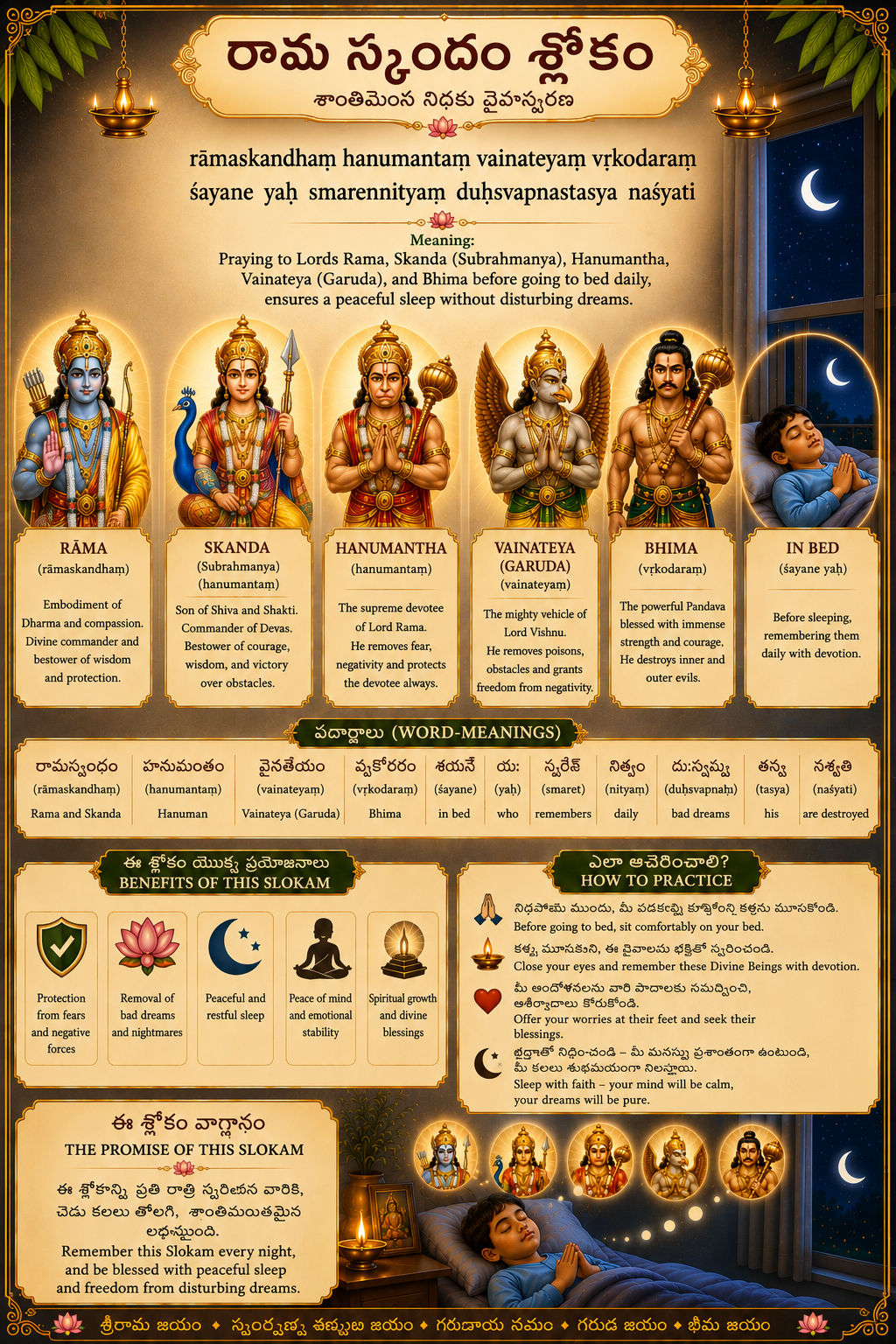
3🌙 Before sleep — to ward off nightmares and bring peaceful dreams

రామస్కందం మంత్రం

Hanuman's Bedtime Protection
Hanuman's Bedtime Protection — రామస్కందం మంత్రం: full sloka with word-by-word meaning and significance
Read as text

రామస్కందం హనూమంతం వైనతేయం వృకోదరం |

శైయనే యః స్మరేన్ నిత్యం దుస్స్వప్నం తస్య నశ్యతి ‖

Word by Word

రామస్కందంbearer of Rama on his shoulders — an epithet for Hanuman
హనూమంతంHanuman — the devoted monkey-god, protector and warrior
వైనతేయంGaruda — son of Vinata, the great eagle who carries Vishnu
వృకోదరంBhima — "wolf-bellied", the mightiest Pandava warrior of the Mahabharata
శైయనేwhile lying down / at sleep
యఃwhoever
స్మరేన్remembers / contemplates
నిత్యంdaily / always
దుస్స్వప్నంbad dreams / nightmares
తస్యtheir
నశ్యతిare destroyed / perish

Significance

A small four-line prayer to three of Hindu lore's mightiest protectors — Hanuman (who carries Rama), Garuda (the divine eagle), and Bhima (the wolf-bellied warrior). Whispered to a child at bedtime, it makes a simple promise: remember these three guardians each night, and bad dreams cannot find you. Often taught by grandmothers across generations — absorbed at age four, remembered for life.

📝 Parent's Notestory, meaning & how to teach this

📖 A grandmother's sloka

Some slokas are taught in temples. Some are taught in schools. This one is taught in the dark — by grandmothers and grandfathers, whispered to a child curled under a blanket who is scared of a noise, a bad dream, or just the night itself.

It is a sloka with a job: keep the bad dreams away. It does that by naming three of the strongest beings in all of Hindu story and asking them to stand watch:

  • Hanuman, the loyal monkey-god who once leapt across an ocean.
  • Garuda, the great eagle who carries Vishnu himself across the sky.
  • Bhima, the wolf-bellied Pandava who could uproot trees with his bare hands.

Three guards. One small bed. Sleep peacefully.

💪 Three protectors, three kinds of strength

The sloka picks three different kinds of strength a child might need — each its own answer to a different kind of fear:

  • 🐒 Hanuman — devotion-strength. Strength that comes from love and trust in something larger. The sloka calls him ramaskandam — "the one who bears Rama on his shoulders." His power doesn't come from his muscles. It comes from his complete trust in Rama.
  • 🦅 Garuda — speed-strength. Son of Vinata, the great eagle who carries Vishnu through the sky. He is the part of us that can rise above fear in a single beat of wings.
  • ⚔️ Bhima — body-strength. Of all the Pandava brothers in the Mahabharata, Bhima was the warrior whose arms made enemies tremble. He is the part of us that can simply not be afraid.

A child has all three of these inside them already. The sloka just reminds them.

⏱ A fifteen-second bedtime ritual

Lights out → child in bed → say the sloka (or just whisper the three names — Hanuman, Garuda, Bhima) → close your eyes → sleep.

If a child is scared, say it together. Some families add a small line at the end — "…and bad dreams cannot find me here" — turning the Sanskrit into a quiet promise.

🌍 A reading for any family

Strip the Sanskrit away and this sloka does what every culture's bedtime prayer does: name the things that protect you, then close your eyes. Christian families say "now I lay me down to sleep." Buddhist families chant a metta verse. This is the Hindu version of the same universal need — I am safe. I am watched over. I can sleep.

For a child afraid of the dark or going through a phase of nightmares, this is medicine in fifteen seconds.

🌙 A whisper that travels through families

Slokas like this travel through families one whisper at a time. They are not memorised from books. They are absorbed at age four, said badly at age six, said properly at age ten, and remembered for life.

If you teach it once to your child, you may be one of those whispers they remember when they have their own children.

📜 More Slokas to Explore

Six more verses for different parts of the day — earth salutation, bath, after meals, universal prayer, evening peace, and end-of-day reflection.

4🌍 Morning — before placing your feet on the ground

భూమి వందన శ్లోకం

Earth Salutation
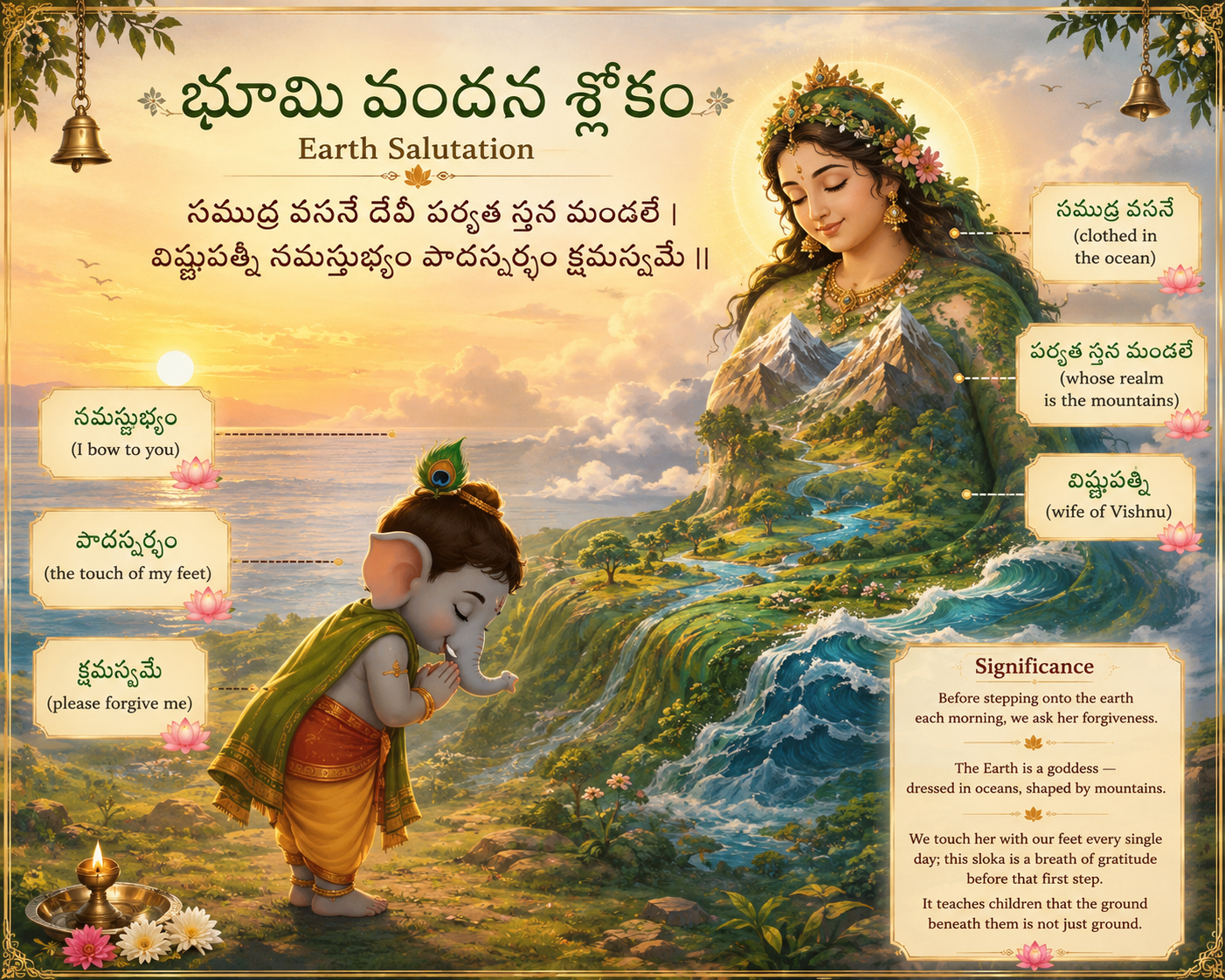
Earth Salutation — భూమి వందన శ్లోకం: full sloka with word-by-word meaning and significance
Read as text

సముద్ర వసనే దేవీ పర్వత స్తన మండలే |

విష్ణుపత్ని నమస్తుభ్యం పాదస్పర్శం క్షమస్వమే ‖

Word by Word

సముద్ర వసనేclothed in the ocean
పర్వత స్తన మండలేwhose realm is the mountains
విష్ణుపత్నిwife of Vishnu
నమస్తుభ్యంI bow to you
పాదస్పర్శంthe touch of my feet
క్షమస్వమేplease forgive me

Significance

Before stepping onto the earth each morning, we ask her forgiveness. The Earth is a goddess — dressed in oceans, shaped by mountains. We touch her with our feet every single day; this sloka is a breath of gratitude before that first step. It teaches children that the ground beneath them is not just ground.

📝 Parent's Notestory, meaning & how to teach this

📖 The story behind Bhudevi

There is an old story: Bhudevi, the Earth Goddess, once sank under the weight of all the cruelty and selfishness humans piled on her. The world began to drown. Vishnu came down as Varaha — a great wild boar — dove into the cosmic ocean, and lifted her back up on his tusks. When he set her down, she rose green and glowing — but tired.

That is why this sloka calls her Vishnu-patni, "wife of Vishnu" — because Vishnu is the one who keeps lifting her back up, age after age. She wears the oceans as her sari. The mountains rise from her body like her own form.

Every morning, before our feet touch the floor, we are about to walk on her body. This sloka is one small "sorry, and thank you" before the day's first step.

🌳 What the sloka teaches

  • 🌊 The Earth has a body. Oceans are her clothing. Mountains are her shape. Rivers run through her. She is not "the ground" — she is a living being.
  • 🐾 You walk on her body all day. Every step is a small impact.
  • 🙏 Asking forgiveness is asking awareness. You can't keep doing harm if you stop and think about it each morning.

⏱ A six-second morning ritual

Before your feet hit the floor → sit on the edge of the bed → say the sloka (or just look at your feet) → then step down gently.

The act of pausing for six seconds is the practice.

🌍 A reading for any family

Strip the goddess away and the sloka is the world's oldest environmental prayer. Long before the word "sustainability" existed, this verse said: the ground beneath you is not a resource. It is alive. Treat it that way.

A family that teaches a child this verse is teaching them ecology disguised as gratitude.

🌙 An evening check-in

Before bed, one small question:

  • Was I gentle with the Earth today? — Did I waste water? Throw something where it didn't belong? Notice a tree, a bird, a river?

One answer, ten seconds.

5🚿 Before bathing — invoking the sacred rivers into the water you use.

నదీ ఆహ్వాన శ్లోకం

Sacred Rivers Invocation
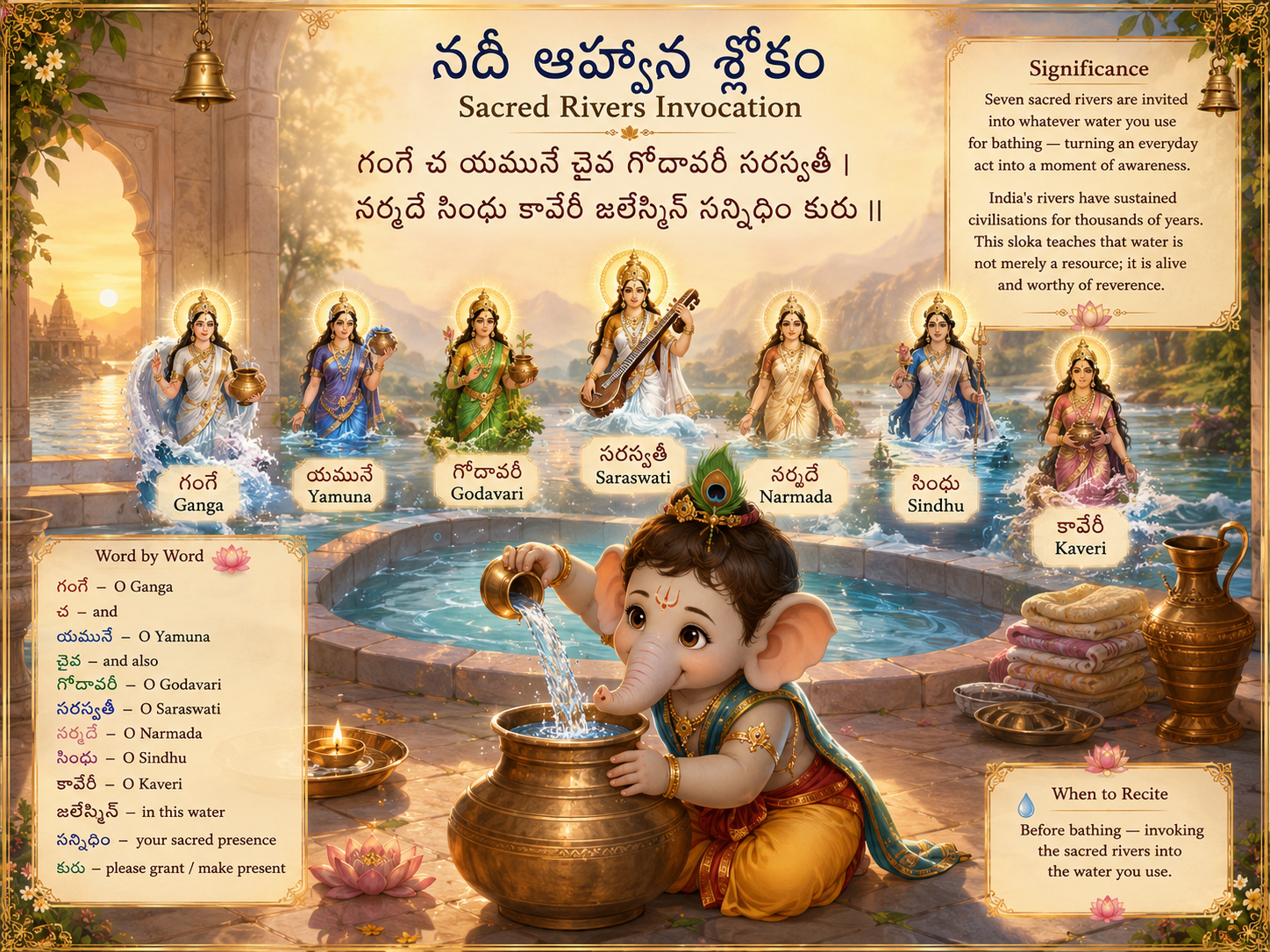
Sacred Rivers Invocation — నదీ ఆహ్వాన శ్లోకం: full sloka with word-by-word meaning and significance
Read as text

గంగే చ యమునే చైవ గోదావరీ సరస్వతీ |

నర్మదే సింధు కావేరీ జలేస్మిన్ సన్నిధిం కురు ‖

Word by Word

గంగేO Ganga
and
యమునేO Yamuna
చైవand also
గోదావరీO Godavari
సరస్వతీO Saraswati
నర్మదేO Narmada
సింధుO Sindhu
కావేరీO Kaveri
జలేస్మిన్in this water
సన్నిధింyour sacred presence
కురుplease grant / make present

Significance

Seven sacred rivers are invited into whatever water you use for bathing — turning an everyday act into a moment of awareness. India's rivers have sustained civilisations for thousands of years. This sloka teaches that water is not merely a resource; it is alive and worthy of reverence.

📝 Parent's Notestory, meaning & how to teach this

📖 Why seven rivers?

Long before maps and atlases, ancient India knew its land by its rivers. Seven of them were so important they had their own personalities — almost their own stories:

  • Ganga the dancer, who came down from heaven to wash away sorrow.
  • Yamuna her gentler twin, blue-black and playful.
  • Saraswati the hidden river, said to flow underground — the river of music and learning.
  • Godavari the elder, "Ganga of the south."
  • Narmada the only river that flows east-to-west, fierce and independent.
  • Sindhu (Indus) — so important the entire country was named after her.
  • Kaveri the southern mother, the river that built Tamil and Kannada lands.

Every time you bathe, this sloka invites all seven into your bucket of water. Not by magic — by memory. By acknowledging that all water everywhere is connected.

💧 What the sloka teaches

  • 🌊 Water is alive. It has names, histories, moods.
  • 🔗 All water is one water. The drop in your hand has been in a river, a cloud, a glacier, an ocean — possibly all four.
  • 🙏 Bathing is a small ceremony. What looks like a daily chore is, with this sloka, a daily greeting to the planet's circulatory system.

⏱ A ten-second bath ritual

Open the tap → hold your hand under the water for one breath → say the sloka (or just name two rivers you remember) → then begin.

Ten seconds. Done.

🌍 A reading for any family

You don't need to believe rivers are goddesses to teach this sloka. The lesson is hydrological: every glass of water in your home has travelled a thousand miles. It has come through rivers ancient civilisations were built on. The sloka is simply asking your child to remember that.

🌙 An evening question (for older kids)

  • Which river fed me today?

The water you drank, cooked with, bathed in — where did it actually come from? In Hyderabad, that's the Krishna. In Chennai, the Kaveri. In Delhi, the Yamuna. Trace it once — your child will never see a tap the same way again.

6🙌 After every meal — giving thanks for the body's quiet work

భోజన అనంతర శ్లోకం

Prayer After Eating

అహం వైశ్వానరో భూత్వా ప్రాణినాం దేహమాశ్రితః |

ప్రాణాపాన సమాయుక్తః పచామ్యన్నం చతుర్విధమ్ ‖

Word by Word

అహంI — the divine speaking through the body
వైశ్వానరఃthe digestive fire within all beings (vaishva = all, nara = being)
భూత్వాhaving become / dwelling as
ప్రాణినాంof all living beings
దేహమాశ్రితఃresiding within the body (deha = body, ashrita = entered)
ప్రాణthe in-breath / upward vital energy
అపానthe out-breath / downward energy
సమాయుక్తఃunited with / combined
పచామిI digest / I cook
అన్నంfood
చతుర్విధమ్of four kinds — chewed, swallowed, licked, and drunk

Significance

From the Bhagavad Gita (15.14). God declares: I am the digestive fire within you — I am the one who processes your food. Even digestion is divine. For children, this is a moment to sit still after a meal, breathe, and feel gratitude for the body's invisible, tireless work.

📝 Parent's Notestory, meaning & how to teach this

📖 The hidden fire inside you

In the Bhagavad Gita (15.14), Krishna says something unusual: I am the digestive fire inside every living being. I am the one cooking your food after you've eaten it.

It is one of the strangest, most beautiful claims in any scripture — that the body's quiet, automatic work, the work it does without you telling it to, is also divine.

Your stomach right now is doing chemistry your brain cannot follow. Your liver is filtering things you don't know exist. Your heart has not asked permission to beat for a single second of your life. The sloka is a way of saying thank you to a body that does its job whether you notice or not.

🔥 What the sloka teaches

  • There are four kinds of food — chewed, swallowed, licked, drunk. The sloka covers every way you take food in.
  • Your breath drives your digestion. "Prana and apana, united" — in-breath and out-breath are what power the digestive fire. Modern medicine agrees: deep breathing literally helps digestion.
  • You are not the one digesting. Something inside you is. Bow to it.

⏱ A four-second pause after eating

Last bite swallowed → push the plate back slightly → hands on belly → one breath → carry on.

The hand on the belly is the trick: it puts your attention on the quiet work happening inside you.

🌍 A reading for any family

This is a gratitude sloka for the body itself. You don't need to believe a deity lives in your stomach to teach a child: your body is doing extraordinary work right now. Notice it. Don't take it for granted.

That's both spiritual and clinical at once.

🌙 An evening check-in

  • Was I kind to my body today? — Did I sleep enough? Drink water? Move? Eat too much sugar?

One honest answer, fifteen seconds.

7🙏 Any time of day — a universal prayer of complete trust

త్వమేవ శ్లోకం

Universal Prayer
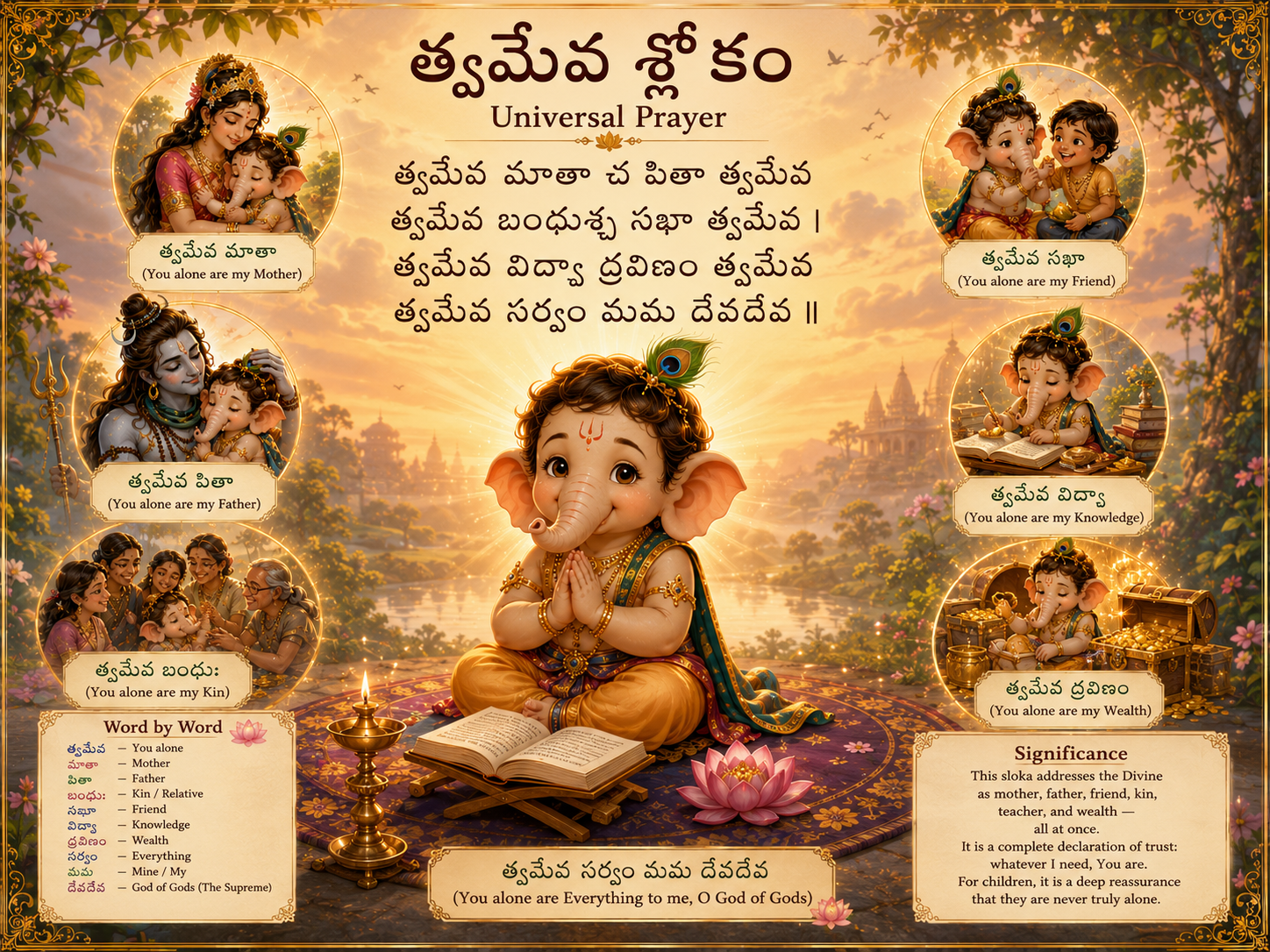
Universal Prayer — త్వమేవ శ్లోకం: full sloka with word-by-word meaning and significance
Read as text

త్వమేవ మాతా చ పితా త్వమేవ

త్వమేవ బంధుశ్చ సఖా త్వమేవ |

త్వమేవ విద్యా ద్రవిణం త్వమేవ

త్వమేవ సర్వం మమ దేవదేవ ‖

Word by Word

త్వమేవyou alone / only you (tvam = you, eva = only)
మాతాmother
and
పితాfather
బంధుఃrelative / kin
సఖాfriend / companion
విద్యాlearning / knowledge
ద్రవిణంwealth / treasure
సర్వంeverything / all
మమmy / mine
దేవదేవGod of gods — the supreme (deva of devas)

Significance

This sloka addresses the divine as mother, father, friend, kin, teacher, and wealth — all at once. It is a complete declaration of trust: whatever I need, you are. For children, it is a deep reassurance: they are never truly alone. It appears in the Pandava Gita and is among the most widely memorised verses in the tradition.

📝 Parent's Notestory, meaning & how to teach this

📖 A song from the lowest moment

This sloka belongs to the Pandava Gita — a quiet stretch of verses said to have been spoken by the five Pandava brothers and their wife Draupadi at the lowest moment of their long exile. Hungry, separated from their kingdom, abandoned by allies — they had nothing left but each other and the sky.

One verse they sang has carried for two thousand years: you alone are my mother, you alone my father, you alone my friend, my kin, my learning, my wealth.

It is not a prayer for things. It is a prayer that says: when I have lost everything, I have not actually lost anything.

🤝 What the sloka teaches

This verse names every kind of love a human depends on — and quietly says all of them flow from one source:

  • Mother and father — the love that holds you up.
  • Friend and kin — the love that walks beside you.
  • Learning and wealth — the love that equips you.
  • Sarvam mama deva-deva — "you are my everything, O God of gods."

For a child who feels small or scared, this is a way of saying: I am never truly alone.

⏱ A ten-second pause — for any moment

Tvameva is special — it has no fixed time. It is the sloka you say whenever you need it. Lost? Scared? Sad? Just before a difficult exam? Sit for ten seconds. Say one line — tvameva sarvam mama deva-deva — "you are my everything." Then carry on.

🌍 A reading for any family

Whatever "you" means to your family — God, the universe, ancestors, life itself, or simply the love your parents wrap you in — this sloka is asking your child to remember that they are held. Believers and non-believers can both teach it honestly: there are forces bigger than you, and they care.

🌙 An evening check-in

  • Who held me up today?

A teacher, a friend, a grandparent, a stranger, a tree, a meal. Naming the answer is the practice.

8🌙 Evening or any time — the most universal of all Vedic prayers

శాంతి మంత్రం

Peace Invocation

అసతోమా సద్గమయా |

తమసోమా జ్యోతిర్గమయా |

మృత్యోర్మా అమృతంగమయా |

ఓం శాంతిః శాంతిః శాంతిః ‖

Word by Word

అసతోfrom untruth / unreality (asat = not-real)
మాme / us
సత్to truth / reality (sat = what truly is)
గమయాlead / take — a humble prayer, not a command
తమసోfrom darkness (tamas = ignorance)
జ్యోతిర్to light / illumination
మృత్యోఃfrom death (mrityu = that which ends)
అమృతంto immortality (a-mrita = not-death; also the nectar of immortality)
ఓంthe primordial sound — the universe in a single syllable
శాంతిఃpeace — chanted three times: peace in body, mind, and the world

Significance

From the Brihadaranyaka Upanishad — the oldest and most universal of all Hindu prayers. It asks not for wealth or victory, but for the movement from ignorance toward understanding. Shanti is chanted three times to address peace within the body, peace within the mind, and peace with the world around us. A prayer every child can genuinely mean.

📝 Parent's Notestory, meaning & how to teach this

📖 The world's oldest prayer

The Brihadaranyaka Upanishad is one of humanity's oldest surviving texts — older than the Bible, older than Buddhism, older than most languages still spoken today. Inside it, tucked among long philosophical dialogues, sits this small prayer.

It does not ask for wealth. It does not ask for victory. It does not ask for love or health or fame.

It asks for three things only:

  • Lead me from the unreal to the real.
  • Lead me from darkness to light.
  • Lead me from death to immortality.

Three thousand years of human beings have whispered this sentence at the end of a long day. It is the most universal prayer in any language.

🕯 What the sloka teaches

  • Asat → Sat (untruth → truth): teach your child to notice when they are pretending, hiding, or lying. Then move toward the honest version.
  • Tamas → Jyoti (darkness → light): not just physical darkness — confusion, fear, anger. Light is clarity.
  • Mrityu → Amritam (death → immortality): not just dying — but the things that end too quickly (joy, friendship, attention). Move toward what lasts.
  • Shanti shanti shanti — peace chanted three times: peace in the body, peace in the mind, peace with the world. All three are needed.

⏱ A twenty-second evening ritual

Lights dimmed → eyes closed → hands resting → say the four lines slowly.

The repetition of shanti three times is the part children remember.

🌍 A reading for any family

This is the rare sloka that mentions no gods. Not one. It is pure aspiration — help me grow toward what is true, clear, and lasting. A Hindu, a Christian, a Buddhist, an atheist can all chant it without changing a word. It is humanity's prayer, not any one religion's.

🌙 An evening check-in

  • One thing today that was real.
  • One thing that was bright.
  • One thing that lasted.

Three small answers. The sloka stops being abstract.

9🌙 Before sleeping — asking forgiveness for wrongs done through the day

రాత్రి క్షమాపణ శ్లోకం

Bedtime Forgiveness Prayer

కరచరణ కృతం వాక్కాయజం కర్మజం వా

శ్రవణ నయనజం వా మానసం వాపరాధమ్ |

విహిత మవిహితం వా సర్వమేతత్ క్షమస్వ

శివ శివ కరుణాబ్ధే శ్రీ మహాదేవ శంభో ‖

Word by Word

కరచరణby hand and foot (kara = hand, charana = foot)
కృతంdone / committed
వాక్కాయజంborn of speech and body (vak = speech, kaya = body)
కర్మజంborn of deeds / action
శ్రవణby the ears / hearing
నయనజంborn of the eyes (nayana = eye)
మానసంof the mind
అపరాధమ్offense / wrong / transgression
విహితంwhat is permitted — things one should have done but did not
అవిహితంwhat is forbidden — things one did that one should not have
సర్వమేతత్all of this (sarva = all, etat = this)
క్షమస్వplease forgive (kshama = forgiveness)
కరుణాబ్ధేocean of compassion (karuna = compassion, abdhi = ocean)
శ్రీ మహాదేవO Great God (Sri = auspicious, Maha = great, Deva = God)
శంభోO Shambho — "giver of joy", a name of Shiva

Significance

The day's final prayer. A complete self-review: wrongs done through hands, feet, speech, body, ears, eyes, or mind — and both sins of commission (did what one should not) and omission (failed to do what one should). Addressed to Shiva as the ocean of compassion. Teaching children to end the day with honest self-reflection and a request for forgiveness is perhaps the most powerful daily habit in this entire set.

📝 Parent's Notestory, meaning & how to teach this

📖 The day's last accounting

Indian tradition has a quiet practice older than most modern self-help: every night, before sleep, you sit for one minute and account for the day.

This sloka is the most thorough version of that practice ever written. It does not ask "did I have a good day?" It asks something harder: did I cause any harm today — through hand, foot, speech, body, ears, eyes, or mind? Whether I should have, or should not have?

Seven channels through which a human can do wrong. The sloka names all seven.

And it is addressed to Shiva as karunaabdhe — "ocean of compassion." Not a stern judge. A kind one.

🌒 What the sloka teaches

  • Forgiveness has two halves: what you did that you shouldn't have (avihitam), and what you didn't do that you should have (vihitam). The sloka names both.
  • The body has seven channels. Hand, foot, speech, body, ear, eye, mind. Each can do harm. Each must be reviewed.
  • The point is not guilt. The point is honesty. End the day clean.

⏱ A one-minute bedtime ritual

In bed → eyes closed → say the sloka (or just name the seven channels in your mind: hand, foot, speech, body, ear, eye, mind) → ask: any harm done? any kindness missed? → ask for forgiveness → sleep.

One minute. The cleanest sleep you'll ever have.

🌍 A reading for any family

Take the deities out and you have the world's most thorough nightly self-review. Therapists recommend it. The Stoics had a version of it — Marcus Aurelius wrote about it 1,800 years ago. The Hindu tradition put it into eight lines and addressed it to a compassionate god instead of a stern one — which makes it easier for a child.

🌙 The sloka is the check-in

This is the only sloka where the daily reflection isn't a separate practice — the sloka does the reflecting for you. Ending the day with this verse, said honestly, is the practice.

These slokas and their meanings are shared with deep respect for the tradition. This presentation is inspired by the teachings of Sri Nanduri Srinivas, whose video "Six Daily Slokas" explains when and why each sloka should be chanted. Students of the Sanatana Dharma Society, Bangalore demonstrated these slokas in that video.

For enquiries about the source material: To.SanatanaDharmaSociety@Gmail.com